0%

Choosing the 2026 Best Drive-In Racking System for Warehouse Storage requires more than comparing prices. It requires practical judgment, accurate measurements, and a clear understanding of product movement. Drive-In Racking System designs can create dense pallet storage by reducing unnecessary aisles. They work especially well for uniform products, stable loads, and high-volume inventory.

Space efficiency matters.

Warehouse consultant and author Gwynne Richards has stated, “The warehouse is no longer just a place to store goods; it is an integral part of the supply chain.” This view remains valuable in 2026. A racking system affects receiving, replenishment, picking, safety, and daily labor. It is not merely a steel structure.

A strong selection process examines pallet dimensions, total load weight, forklift access, storage depth, and turnover rates. It also considers whether LIFO storage suits the operation. That assumption can fail when older stock must leave first. Temperature, floor quality, fire protection, and local safety requirements deserve equal attention. Real warehouses are rarely perfect. Floors may slope slightly. Forklift operators may need wider entry lanes. Product sizes may change during the year.

This guide compares key Drive-In Racking System features, construction details, benefits, limitations, and maintenance needs. It also highlights common planning mistakes. The best system is not always the densest one. It is the design that safely supports reliable warehouse performance.
2026 Best Drive In Racking System for Warehouse Storage

What Is a Drive-In Racking System?

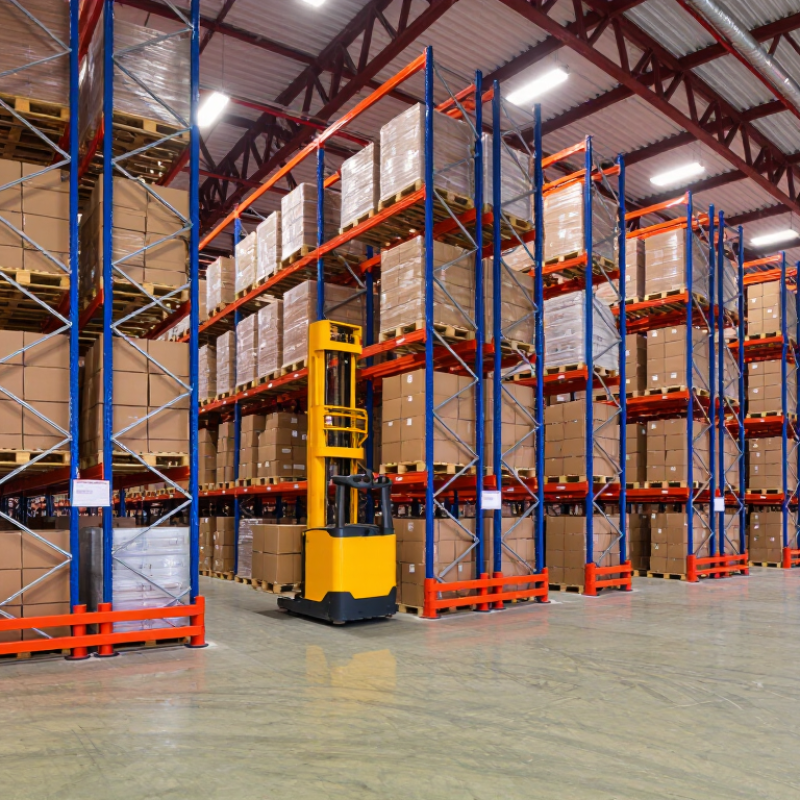
A drive-in racking system lets forklifts enter storage lanes through the rack face. Rails support pallets at several depths, creating dense block storage with fewer aisles. It usually follows a last-in, first-out flow, although drive-through layouts can support first-in, first-out handling. The system suits warehouses holding many pallets of the same product. It is not ideal for hundreds of single-pallet SKUs.

The design is simple, but the operating details matter. Pallets must have consistent dimensions and strong bottom boards. Forklift drivers need clear tunnel visibility, controlled speed, and accurate positioning. Rack frames also require protection from impact. OSHA’s 29 CFR 1910.176(b) requires storage areas to remain clear and safe for material movement. In practice, I would add daily checks for bent rails, damaged uprights, and uneven pallets.

Warehouse Efficiency The 2024 MHI Annual Industry Report states that 79% of surveyed supply-chain professionals expected to adopt robotics and automation within five years. That figure supports better inventory control, but it does not make drive-in racks intelligent. A location system, barcode discipline, and regular cycle counts remain necessary. A 2024 logistics industry survey by CBRE also identified warehouse efficiency as a major investment priority. Yet density can hide older stock. That is the uncomfortable weakness. Without strict batch control, a full lane may look productive while slowing retrieval. Proper lane depth, load capacity, fire clearance, and inspection records should be confirmed before installation. Get the spacing wrong. Forklifts will reveal it quickly.

How Drive-In Racking Systems Work

2026 Best Drive In Racking System for Warehouse Storage

How Drive-In Racking Systems Work

Drive-in racking creates deep storage lanes for pallets with similar products. Upright frames stand in rows, while horizontal rails support pallet runners. A forklift enters the lane and places pallets from the back toward the front. The operator removes the front pallet first. This creates a last-in, first-out storage pattern.

The system uses warehouse height and depth efficiently. It can reduce unused aisles in facilities with stable inventory. Cold storage, bulk materials, and seasonal goods often suit this design. In daily operation, the forklift must travel slowly and stay centered. Small steering errors can damage rails or pallet supports. Clear load ratings are essential.

Drive-through layouts allow access from both ends. They can support a first-in, first-out process when loading and unloading are controlled. Yet, product rotation may become confusing during busy shifts. I have found that simple lane labels help more than complicated software alone. Staff training matters.

There is a practical weakness. Deep lanes limit direct access to every pallet. Damaged packaging may also remain hidden behind newer loads. Regular inspections should check rails, frames, pallets, and floor conditions.

A careful warehouse manager should review traffic patterns before choosing this system. Maximum density is useful, but it should never replace safe handling space.

Key Components and Storage Configurations

2026 Best Drive In Racking System for Warehouse Storage

Key Components and Storage Configurations

A drive-in racking system uses upright frames, horizontal load rails, top bracing, and rear supports. Each component must match the pallet load and forklift movement. Load rails carry pallets inside each storage lane. Entry guides help operators align forks with less impact. Upright guards protect the frames near busy travel paths. Rear stops prevent pallets from being pushed too far.

Storage configuration determines both capacity and handling speed. A single-entry layout works well against a wall and supports last-in, first-out rotation. A double-entry layout allows access from both sides, increasing flexibility. Deep lanes store many pallets, but they can slow product selection. Shorter lanes usually improve control when inventory changes often. Temperature-controlled warehouses may benefit from dense layouts, where floor space is expensive.

Site measurements should include pallet dimensions, load weight, aisle width, ceiling height, and forklift clearance. A practical inspection also checks damaged rails, uneven floors, and poor visibility at lane entrances. Small clearance errors become serious during repeated loading. They should not be ignored.

One design mistake is choosing maximum density without studying turnover. High density looks efficient. It can become restrictive. Clear signage, impact protection, routine inspections, and trained operators support safer daily use. Engineers should verify capacity calculations and local storage requirements before installation. Even a well-designed system needs adjustment after real operating conditions appear.

2026 Best Drive-In Racking System for Warehouse Storage - Key Components and Storage Configurations

Planning reference for pallet capacity, system components, operating requirements, and storage configurations

Category Key Item Typical Specification or Range Storage Configuration Planning and Operating Considerations
System Type Drive-In Pallet Rack Single-entry, high-density storage using continuous storage lanes Last-in, first-out (LIFO) Suitable for large quantities of the same or limited stock-keeping units where inventory rotation is not the primary requirement.
System Type Drive-Through Pallet Rack Access from both ends of the storage lane First-in, first-out (FIFO) is possible when loading and unloading are separated Requires two-sided aisle planning and coordinated forklift traffic. It normally uses more floor space than a single-entry drive-in layout.
Pallet Handling Standard Pallet Footprint Common planning sizes include 1,200 × 1,000 mm and 1,200 × 800 mm One pallet per storage position across the lane width The actual pallet footprint, entry direction, load overhang, and pallet condition must be confirmed before designing rail spacing.
Pallet Handling Unit Load Weight Often planned in the 500–1,500 kg range per pallet, subject to engineering approval Uniform loads are preferred within each lane Rack capacity depends on beam or rail span, upright frame, lane depth, pallet support, seismic conditions, and the number of stored levels.
Structural Components Upright Frames Cold-formed steel frames with engineered column profiles and diagonal bracing Form the vertical structure at the front, rear, and intermediate positions Frame size and steel thickness must be selected from calculated loads rather than from a generic height or weight table.
Structural Components Load Rails Horizontal rails support pallet runners or pallet beams at each storage level Continuous rails run along both sides of each lane Rail spacing should support the pallet safely and limit pallet deflection. Damaged or missing rails must not be used for storage.
Structural Components Top, Rear, and Longitudinal Bracing Bracing assemblies stabilize the rack in the vertical and horizontal directions Installed at selected bays, roof levels, rear faces, and rack ends Brace layout varies with rack height, lane depth, wind or seismic requirements, and the building interface.
Structural Components Guide Rails and Entry Guides Steel guide members or reinforced entry components at the lane entrance Protect the rack structure during forklift entry Entry guides help align the truck but do not replace operator training, impact protection, or a defined operating clearance.
Protection Upright Guards Steel or polymer guards positioned at exposed rack columns Typically installed at front corners, aisle ends, and other impact-prone locations Protection requirements should be based on truck type, operating speed, aisle geometry, and local workplace safety rules.
Protection End-of-Aisle Protection Guardrails, bollards, barriers, or reinforced end frames Protects rack ends and pedestrian interfaces Keep fire exits, emergency equipment, doors, and pedestrian routes unobstructed at all times.
Rack Dimensions Lane Depth Common planning range: approximately 4–10 pallet positions deep Greater depth increases density but reduces direct access to individual pallets Depth should reflect inventory volume, product rotation, forklift reach, pallet stability, and the required retrieval sequence.
Rack Dimensions Storage Height Frequently designed around 2–6 pallet levels; total height is commonly about 4–10 m Multiple vertical storage levels above the floor position Final height is limited by clear building height, sprinkler clearance, forklift lift height, seismic design, and safe operating visibility.
Rack Dimensions Vertical Load Clearance Typically allow approximately 75–150 mm above the loaded pallet, subject to the truck and load profile Clearance is required between the load, rail, and the level above The minimum clearance must account for pallet deflection, load variation, forklift mast movement, and installation tolerances.
Rack Dimensions Operating Aisle Width Often approximately 3.0–4.0 m for conventional counterbalance trucks; narrower aisles may suit reach or specialized trucks One or more loading aisles serve the rack face Use the forklift manufacturer's turning-radius and minimum-aisle data. Actual width also depends on pallet length, load overhang, and operator practice.
Storage Configuration Single-SKU Lane One product type or lot assigned to each lane Best fit for high-volume, low-variety inventory Reduces sorting errors and makes LIFO control easier. Lane identification and stock records remain essential.
Storage Configuration Multi-Lane Product Zoning Separate lanes grouped by product family, temperature zone, lot, or handling requirement Several lanes share the same rack block while maintaining product separation Provide clear labels and physical separation where mixed lots, allergens, hazardous materials, or temperature-sensitive goods are involved.
Storage Configuration FIFO Drive-Through Arrangement Loading side and retrieval side are physically separated Goods enter from one side and leave from the opposite side This arrangement supports better stock rotation but requires additional travel paths, aisle control, and accurate loading discipline.
Storage Configuration Temperature-Controlled Storage Drive-in rack installed inside chilled or frozen areas with suitable corrosion and material controls High-density storage for temperature-sensitive palletized goods Allow for condensation, reduced visibility, floor conditions, fire protection, and any clearance required by the refrigeration system.
Forklift Compatibility Forklift Entry Height Mast, overhead guard, fork carriage, and load must fit within the designed entry profile Truck enters the lane beneath or between structural members Verify maximum truck height, fork length, turning behavior, load center, and reach capability before selecting the rack configuration.
Forklift Compatibility Fork Length and Load Center Forks must support the pallet without excessive protrusion or contact with the rear structure Load is deposited directly onto the side rails or pallet supports Fork length and load center affect pallet support, maneuverability, rack impact risk, and the required lane-end clearance.
Capacity Planning Storage Density Can provide substantially higher pallet density than selective rack by reducing access aisles High occupancy with fewer direct-access positions The practical gain depends on building shape, pallet mix, lane depth, turnover, fire aisles, and the number of stock-keeping units.
Capacity Planning Recommended Occupancy Target Operational planning commonly targets about 80–90% occupied pallet positions Maintains usable capacity while preserving loading and retrieval flexibility A completely full system can slow replenishment and make stock rotation difficult. The appropriate target depends on demand variability and lane assignment.
Safety and Compliance Load Plaques and Identification Visible signs showing approved load limits, pallet type, and operating restrictions Placed at rack entrances and other clearly visible locations Do not exceed posted capacities. Any change to beam levels, pallet type, or system layout should be reviewed by a qualified rack designer.
Safety and Compliance Inspection and Maintenance Routine visual checks plus documented periodic inspections Checks cover uprights, rails, bracing, anchors, guards, pallets, and floor conditions Quarantine damaged rack components and pallets until assessed. Inspection frequency should follow local regulations, site risk, and the rack manufacturer's instructions.
Selection Criteria Best Application Profile High-volume inventory with relatively few stock-keeping units and stable pallet dimensions Deep-lane LIFO or FIFO storage depending on access design Drive-in racking is generally less suitable for high-SKU operations requiring frequent individual pallet access.
Selection Criteria Design Verification Site-specific engineering review before purchase or installation Confirms rack loads, building conditions, forklift operation, fire protection, and local code requirements Final dimensions and capacities must be determined from verified site measurements and engineered calculations rather than generic planning ranges.
Planning note: The dimensions and ranges shown are common preliminary planning values for pallet drive-in and drive-through systems. Final rack capacity, clearances, anchoring, seismic resistance, fire-protection provisions, and operating procedures must be verified for the specific building, pallet, load, forklift, and applicable safety requirements.

How to Choose the Best System for 2026

2026 Best Drive In Racking System for Warehouse Storage

Choosing the best drive-in racking system for 2026 starts with warehouse behavior, not maximum pallet capacity. Drive-in racks suit stable products with few stock-keeping units and large pallet quantities. They normally support last-in, first-out access, while drive-through layouts can support first-in, first-out movement. Confirm this requirement before comparing prices.

MHI’s 2024 Annual Industry Report found that 83% of supply chain professionals expect greater use of robotics and automation within the next one to two years. That trend makes forklift access, rack protection, and future equipment compatibility important. Measure pallet dimensions, load weight, aisle depth, ceiling height, and daily pallet movements. Ask an experienced rack engineer to review seismic conditions and floor strength. A perfect spreadsheet still misses real collision risks.

Tips: Keep fast-moving items near the entrance. Use clear rack labels and physical load signs. Inspect uprights, rails, and guards regularly. Choose a layout that leaves safe turning space, even if it stores fewer pallets. In practice, the densest option is not always the best option. Operators may lose time searching deep lanes, and damaged rails can create expensive downtime. Review the design after a trial installation, because warehouse traffic rarely behaves exactly as planned.

Installation, Safety, and Maintenance Requirements

Drive-in racking can increase pallet density, but installation quality controls its real value. The system requires a level, load-rated floor and verified aisle clearances. Each upright must match the approved structural drawings. Rails should sit evenly, without twisted supports or missing locks. A forklift should enter squarely, at low speed, with forks centered beneath the pallet.

The U.S. Bureau of Labor Statistics reported 89 fatal occupational injuries in warehousing and storage during 2023. This figure reinforces the need for controlled traffic and disciplined inspections. OSHA 29 CFR 1910.176(b) requires stored materials to remain stable and secure against sliding or collapse. ANSI MH16.1-2023 also provides engineering requirements for industrial steel storage racks. Installers should record anchor torque, frame alignment, rail levels, and every approved load rating. Small gaps become serious problems.

Maintenance needs a visible routine. Operators should check damaged uprights, bent rails, loose anchors, pallet overhang, and impact marks each shift. A competent person should complete a documented inspection at least monthly. An engineer should review significant damage before reuse. Replace damaged parts; do not straighten them in place. That shortcut is tempting. It is also difficult to defend. Cleaning beneath the lanes prevents debris from lifting pallets or obstructing forklift wheels. Warning signs should remain readable near every entry. Periodic refresher training matters, although busy facilities often postpone it. That weakness deserves attention.

2026 Best Drive-In Racking System for Warehouse Storage

Recommended installation, safety, and maintenance requirements for drive-in pallet racking.

The chart summarizes practical control points for warehouse drive-in racking. Installation requires accurate alignment and anchoring, safety depends on operator protection and load control, and maintenance requires routine inspections, prompt repair of damaged components, and periodic reassessment of load capacity.

FAQS

How does a drive-in racking system store pallets?

Forklifts enter deep lanes and place pallets from the back forward. Operators remove the front pallet first. This creates a last-in, first-out pattern.

Which products suit drive-in racking best?

It suits stable products with few product types and many identical pallets. Seasonal goods, bulk materials, and cold-storage items may fit well. Fast-changing inventory may not.

Can this system support first-in, first-out rotation?

A drive-through layout allows access from both ends. It can support first-in, first-out movement with controlled loading and unloading. Busy shifts can still cause confusion.

What measurements should be checked before installation?

Measure pallet length, width, height, weight, aisle width, ceiling height, and forklift clearance. Check floor strength and uneven areas. Small errors become serious over time.

What are the main components of this storage system?

Upright frames, load rails, top bracing, rear supports, entry guides, frame guards, and rear stops form the main structure. Each part must match the pallet load.

How can operators use drive-in racks more safely?

Forklift drivers should travel slowly and remain centered inside each lane. Clear signs and entry guides reduce alignment mistakes. Safe turning space still matters.

What problems can deep storage create?

Deep lanes limit direct access to individual pallets. Damaged packaging may stay hidden behind newer loads. Searching can also take longer than expected.

How often should the racking system be inspected?

Inspect rails, frames, guards, pallets, floors, and lane visibility regularly. Look for bent steel, cracks, impact marks, and unstable loads. A perfect plan cannot prevent every collision.

Is maximum pallet density always the best choice?

No. Density helps. It may reduce aisles but restrict access and slow product selection. Real warehouse traffic can surprise a careful design.

Can the system support future automation?

Review forklift clearance, rack protection, lane access, and equipment compatibility before installation. Automated equipment may require different spaces. Future plans should remain flexible.

Conclusion

A Drive-In Racking System is a high-density warehouse storage solution designed to maximize available floor and vertical space. Unlike conventional selective racks, it allows forklifts to enter storage lanes and place pallets on rails, making it ideal for large quantities of similar products with limited variation. The system operates through carefully planned entry and retrieval methods, such as last-in, first-out or, with suitable configurations, first-in, first-out. Key components include upright frames, guide rails, support beams, entry protectors, and safety features, while storage layouts can be customized according to pallet dimensions, load capacity, and warehouse height.

When choosing the best system for 2026, businesses should evaluate product turnover, inventory rotation, equipment compatibility, space utilization, and future expansion needs. Professional installation is essential to ensure structural stability, accurate alignment, and safe forklift movement. Regular inspections, load-limit checks, rail maintenance, and operator training help preserve performance and reduce operational risks. With proper planning and upkeep, this system can provide efficient, durable, and space-saving warehouse storage.

Charlotte

Charlotte

Charlotte is a professional marketing specialist with a strong understanding of product strategy, customer needs, and digital communication. As a dedicated member of our team, she combines market insight with practical product knowledge to create clear, useful, and engaging content for our company......
+60 11-3302 1235[email protected]