Precision-engineered industrial storage components and heavy-duty rack systems manufactured under ISO 9001:2015 standards for international logistics networks.
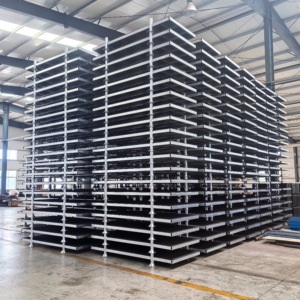
Combining advanced automated roll-forming tech, strict metallurgical quality assurance, and end-to-end turnkey project execution for modern intra-logistics ecosystems.
Top-tier Chinese OEM exporters utilize high-tensile cold-rolled Q235B and Q355 structural steel. Continuously punched profiles and automated 80-meter roll-forming lines guarantee rigid dimensional tolerances, eliminating stress points across multi-tier upright frames.
Long-term structural integrity requires superior corrosion defense. Industrial manufacturers implement a 9-stage automatic chemical pretreatment process (degreasing, phosphating, pure water rinsing) prior to thermosetting epoxy powder coating or hot-dip galvanizing.
From initial CAD layout drafting and Finite Element Analysis (FEA) to safe export packaging and global site installation guidance, certified Chinese factories adhere to European FEM standards and US RMI specifications, ensuring complete warehouse safety.
Detailed comparison of structural load thresholds, operational handling mechanisms, and spatial utilization metrics for modern warehouse planning.
| Storage System Type | Primary Material Standard | Load Capacity Range | Handling System | Volumetric Efficiency | Optimal Industry Application |
|---|---|---|---|---|---|
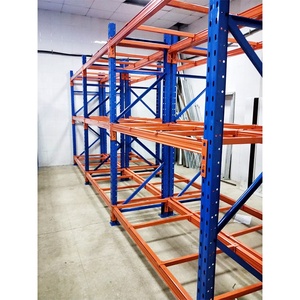
| Heavy Duty Selective Pallet Rack | Q235B / Q355 Steel Columns | 1,000 kg – 4,500 kg / Level | Reach Trucks / Counterbalance | 40% – 50% Spatial Use | 3PL FMCG, High SKU Distribution |
| Radio Shuttle High-Density Rack | Precision Formed Profiles + Rail | 1,500 kg / Pallet Position | Semi-Automated Shuttle Cart | 75% – 85% Spatial Use | Cold Storage, Food & Beverage |
| Drive-In / Drive-Thru Racking | Heavy Duty Uprights & Bracing | 1,000 kg – 2,000 kg / Level | Standard Forklifts (In-Lane) | 65% – 75% Spatial Use | Bulk Raw Materials, Seasonal Stock |
| Carton Gravity Flow Rack | Aluminum / Sheet Metal Roller Rails | 300 kg – 1,000 kg / Shelf | Manual Pick / Conveyor Integrated | 60% Picking Density | E-commerce Order Fulfillment, Automotive |
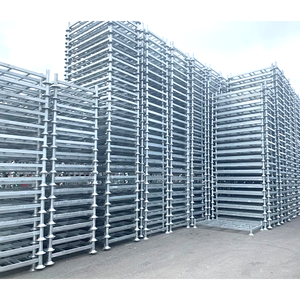
| Galvanized Stackable Post Pallets | Hot-Dip Galvanized Mild Steel | 1,000 kg – 2,000 kg / Unit | Forklift / Stacker Crane | Flexible Modular Stacking | Textile Rolls, Rubber Tires, Chemical Drums |
| Mezzanine Platform Floor | H-Beam Columns & Deck Plates | 300 kg – 1,200 kg / m² | Stairs, Lifts, Pallet Gates | Doubles Floor Footprint | Parts Assembly, Archive Storage, Offices |
Key macroeconomic, technological, and environmental developments altering global supply chain criteria for industrial structural systems.
Traditional static pallet racking is rapidly evolving into dynamic, rack-supported automated structures. Global procurement is shifting toward ultra-precise tolerances required for Autonomous Mobile Robots (AMR), Automated Guided Vehicles (AGV), and high-speed stacker cranes. Chinese factories are integrating CNC laser-drilling and robot welding to meet zero-deflection standards for high-bay AS/RS systems reaching heights over 30 meters.
Environmental regulatory compliance and Scope 3 emissions reporting are driving demand for decarbonized steel supply chains. Premier Chinese exporters are adopting scrap-based Electric Arc Furnace (EAF) steel alongside eco-friendly non-toxic powder coating processes. Buyers now prioritize suppliers offering Environmental Product Declarations (EPD) and ISO 14064 Carbon Footprint Verification to satisfy corporate sustainability mandates.
Modern distribution hubs are embedding wireless IoT load sensors and tilt indicators directly within main racking uprights and beam connectors. Real-time telemetry detects accidental forklift impacts, dynamic overload fatigue, and structural displacement. Chinese engineering teams are providing pre-milled structural profiles designed for rapid sensor mounting and cloud-based predictive maintenance integration.
How structural engineering breakthroughs are maximizing load-to-weight ratios and expanding modular flexibility.
Transitioning from basic Q235 steel to micro-alloyed Q355B and Q460 structural steels allows manufacturers to reduce cross-sectional wall thickness while increasing total beam load capacity. Advanced cold-forming geometry—incorporating multiple stiffening ribs along upright web faces—enhances torsional resistance and overall column buckling resistance under extreme dynamic loading.
Industrial racking designs are moving away from traditional bolted beam-to-frame assemblies toward multi-claw self-locking connector hooks. Engineered pitch adjustments (such as 50mm, 75mm, or 76.2mm metric standards) feature automatic safety locks that engage upon insertion. This drastically reduces on-site installation labor times while maintaining high moment connection stiffness.
To combat aggressive operating conditions—such as cold-chain freezing stores (-30°C) or humid coastal environments—manufacturers are developing hybrid surface finishes. Combining a hot-dip galvanized base layer with an outer electrostatic powder topcoat provides dual-action sacrificial cathodic protection alongside chip-resistant aesthetic finishing.
Expert responses to critical commercial, technical, and logistical questions encountered during international factory sourcing.
Request third-party material mill test certificates (MTC) proving steel grade chemical composition (e.g., Q235B/Q355B). Additionally, insist on finite element analysis (FEA) calculation reports validated against international structural standards such as European FEM 10.2.02, US RMI specifications, or Australian AS4084-2012. Professional Chinese factories provide certified load tables based on Uniformly Distributed Load (UDL) ratings.
Powder coating involves electrostatic application of epoxy-polyester paint cured at 200°C, offering excellent scratch resistance, color coding, and cost efficiency for indoor ambient warehouses. Hot-Dip Galvanizing (HDG) immerses steel components in molten zinc, creating a thick metallurgical zinc-iron alloy coating. HDG is essential for outdoor storage, high-humidity environments, and cold-storage facilities where condensation causes rapid corrosion.
To calculate structural beam sections and aisle layouts, supply your building's clear height (to lowest ceiling beam or sprinkler line), floor slab flatnesses/thickness, concrete compressive strength (e.g., C25/C30 grade), door/column grid locations, pallet dimensions (W x D x H), gross weight per pallet, and the minimum aisle turning radius required by your specific forklift fleet.
Leading factories utilize heavy-duty export packaging protocols. Upright frames and beams are bundled with plastic strapping, wrapped in protective bubble film, and supported by timber or steel dunnage feet for safe forklift loading. Small accessories (baseplates, safety pins, row spacers) are packed in reinforced wooden cases or corrugated cartons secured to export pallets to prevent transit damage or ocean freight moisture degradation.
Yes. Chinese OEMs specialize in full engineering customization. Roll-forming tooling can be tailored to specify column profiles (e.g., 80mm, 90mm, 100mm, 120mm web widths), steel gauge thicknesses (1.5mm to 3.0mm), beam profile heights (80mm to 160mm box beams), and custom frame depths to accommodate unique pallet overhangs or non-standard industrial containers.
If your installation site is located in an active seismic zone, the racking system must feature upgraded baseplate surface areas, high-tensile concrete anchor bolts, reinforced frame bracing patterns, and heavier column gauges. Certified factories calculate seismic acceleration parameters (PGA values) to ensure total frame stability under lateral earthquake forces.